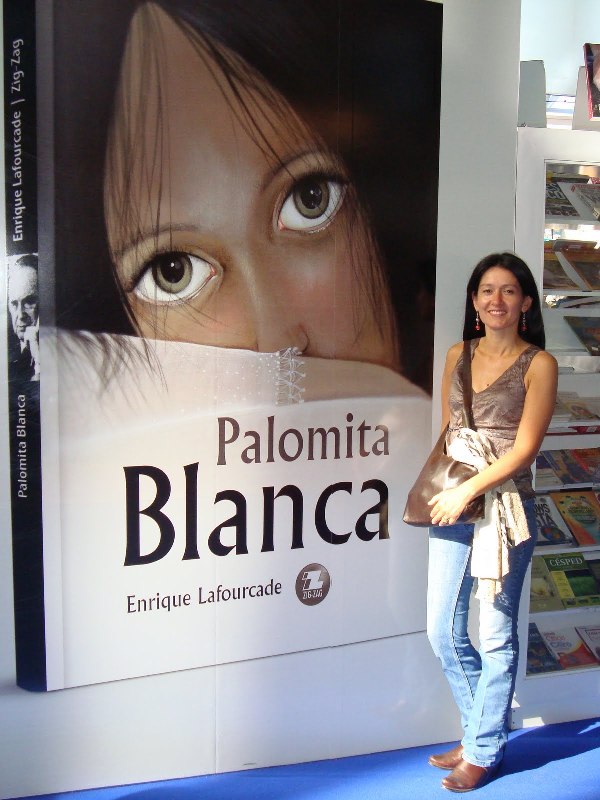
Ilustracja na okładce - Maria Jose Olavarria Madariaga
Wydawnictwo - Zig-Zag
Palomita Blanca (Spanish for "Little White Dove") is a 1971 novel written by Enrique Lafourcade. More than fifty editions (including "reprintings") have been published, making the novel the most widely sold novel in the history of Chilean literature, with more than a million copies sold.[1] It was written at a conflictive time in Chile's history (events leading into the election of Salvador Allende as President) and it was a sentimental time in world popular culture (events such as rock concerts and drug use). Most critics saw the novel as a knee-jerk response to Erich Segal's Love Story. A New York Times No. 1 bestseller, Segal's book became the top selling work of fiction for all of 1970 in the United States, and was translated into more than 20 languages worldwide. The motion picture of the same name was the number one box office attraction of 1971. Thus most media comments in Santiago called Lafourcade's novel "the Chilean love story." Lafourcade's marriage with Marta Blanco had ended three years earlier, and he reportedly wrote the novel inspired by his later pareja, about whom he remained quite secretive. A film based on the novel was made in 1973 by Raúl Ruiz, which was at one time believed lost forever, but a print was later found in the vaults of ChileFilms. Music for the film was written and performed by Los Jaivas. A translation to Portuguese was published in Brazil, but a translation to English by Joel Hancock of the University of Utah has remained unpublished.
Cote i Palomita Blanca:)
(zdjęcie i informacja ze strony: http://cotepinta.blogspot.com/)
Sweet Jane
Standing on the corner
Suitcase in my hand
Jack's in his corset, Jane is in her vest
Me, honey, I'm in a rock 'n' roll band
Ridin' in a Stutz Bearcat, Jim
You know those were different times
All, all the poets they studied rules of verse
And those ladies they rolled their eyes
Sweet Jane
Sweet Jane
Sweet Jane
Jack, he is a banker
And Jane, she is a clerk
And Both of them save their money
When they come home from work
Sittin' down by the fire
Radio does play, look classical music there, kids
"The March Of The Wooden Soldiers"
You can hear Jack say
Sweet Jane
Sweet Jane
Sweet Jane
Some people like to go out dancing
And other people like us, we gotta work
And there's even some evil mothers
They're gonna tell you that everything is just dirt
And you know that women never really faint
And that villains always blink their eyes
That children are the only ones who blush
And that life is just to die
Anyone who ever had a heart
And wouldn't turn around and break it
Anyone who ever played a part
And wouldn't turn around and hate it
Sweet Jane
Sweet Jane
Sweet Jane
Sweet Jane, Sweet Jane
Sweet Jane, oh honey, Sweet Jane
Sweet Jane, oh, Sweet Jane
Sweet Jane, Sweet Jane
Dark City (1998) Rzeczywistość z pogranicza jawy i snu. Młody mężczyzna budzi się w pokoju hotelowym. Nic nie pamięta, a na podłodze znajduje trupa dziewczyny. Z dokumentów, które przy sobie znajduje dowiaduje się, że nazywa się John Murdoch. Ucieka z obcego sobie miejsca, a jego tropem podąża policja i dziwni ludzie w czarnych ubraniach o bladych twarzach. Okazuje się, że to ci ostatni sterują wydarzeniami tego świata. O północy miasto zamiera: wszyscy - nawet na stojąco - zasypiają, a tajemnicze czarne postaci przenoszą ich bezwładne ciała z jednego miejsca w inne wymazując z ich mózgu wspomnienia... John ma bardzo niewiele czasu na rozwikłanie zagadki, gdyż po piętach depcze mu inspektor policji...
Obsada: Rufus Sewell - John Murdoch Jennifer Connelly - Emma Murdoch/Anna Kiefer Sutherland - Dr Daniel Poe Schreber William Hurt - Inspektor Frank Bumstead Colin Friels - Eddie Walenski Richard O'Brien - Mr Hand Satya Gumbert - Mr Sleep Noah Gumbert - Mr Sleep Filming Double Nicholas Bell - Mr Rain Bruce Spence - Mr Wall
Muzyka: Trevor Jones Gary Numan
Zdjęcia: Dariusz Wolski
Kostiumy: Liz Keogh
Song: Rumours about angels Album:One of 18 angels (2000) By Diary of Dreams
Film: Dark City (1998) Directed by Alex Proyas
Lyrics: I will plaster all you mortals with my dominating guts I will torment revelations - I did never ask for much I will taste the detonation while the geminis go wild I'll absorb the human sigh, eradicate your dormant lie
Does it suck your breasts for milk, golden honey, dressed in silk Does it feel your patient care in your dreadful glassy stare or does it feel your true emotions in its scars and bruises burn Do you really think your lies will tear open cloudy skies?
Feel my fingers in your wound while my eyes ascend the gloom Questions wasting all my time - I see your eyes detesting mine Sick of a life you never had, e.dead.motion, you look so sad I could care less if I'd like - I let you go into the night
Is my ignorance my fate, or is my love distorted hate Is deliverance my mate or am I sleeping while awake Is this place that we call home adorned by devastating foam Am I mortal, am I god - Am I brighter than you thought?
I will never beg for mercy - I will never kiss your feet I will never ask forgiveness and all of that I want to keep! I will guide the blind in darkness though I cannot see myself I will whisper in a deaf ear while I know you cannot speak
Margarita, está linda la mar, y el viento lleva esencia sutil de azahar; yo siento en el alma una alondra contar: tu acento. Margarita, te voy a contar un cuento.
Este era un rey que tenía un palacio de diamantes, una tienda hecha del día y un rebaño de elefantes.
Un kiosco de malaquita, un gran manto de tisú, y una gentil princesita, tan bonita, Margarita, tan bonita como tú.
Una tarde la princesa vio una estrella aparecer; la princesa era traviesa y la quiso ir a coger.
La quería para hacerla decorar un prendedor, con un verso y una perla, y una pluma y una flor.
Las princesas primorosas se parecen mucho a ti: cortan lirios, cortan rosas, cortan astros. Son así.
Pues se fue la niña bella, bajo el cielo y sobre el mar, a cortar la blanca estrella que la hacía suspirar.
Y siguió camino arriba, por la luna y más allá; más lo malo es que ella iba sin permiso del papá.
Cuando estuvo ya de vuelta de los parques del Señor, se miraba toda envuelta en un dulce resplandor.
Y el rey dijo: "¿Qué te has hecho? Te he buscado y no te hallé; y ¿qué tienes en el pecho, que encendido se te ve?"
La princesa no mentía, y asi, dijo la verdad: "Fui a cortar la estrella mía a la azul inmensidad".
Y el rey clama: "¿No te he dicho que el azul no hay que tocar? ¡Qué locura! ¡Qué capricho! El Señor se va a enojar".
Y dice ella: "No hubo intento; yo me fui no sé por qué; por las olas y en el viento fui a la estrella y la corté".
Y el papá dice enojado: "Un castigo has de tener: vuelve al cielo, y lo robado vas ahora a devolver".
La princesa se entristece por su dulce flor de luz, cuando entonces aparece sonriendo el Buen Jesús.
Y así dice: "En mis campiñas esa rosa le ofrecí: son mis flores de las niñas que al soñar piensan en mí". ***
Viste el rey ropas brillantes, y luego hacer desfilar cuatrocientos elefantes a la orilla de la mar.
La princesita está bella, pues ya tiene el prendedor en que lucen, con la estrella, verso, perla, pluma y flor.
Margarita, está linda la mar, y el viento lleva esencia sutil de azahar: tu aliento. Ya que lejos de mí vas a estar, guarda, niña, un gentil pensamiento al que un día te quiso contar un cuento.